Solar 9 min read
Is solar worth it in Kent? Payback worked out with local figures
Is solar worth it in Kent? Worked figures for Sevenoaks, Tonbridge and Maidstone at the October 2026 price cap, with and without a battery.

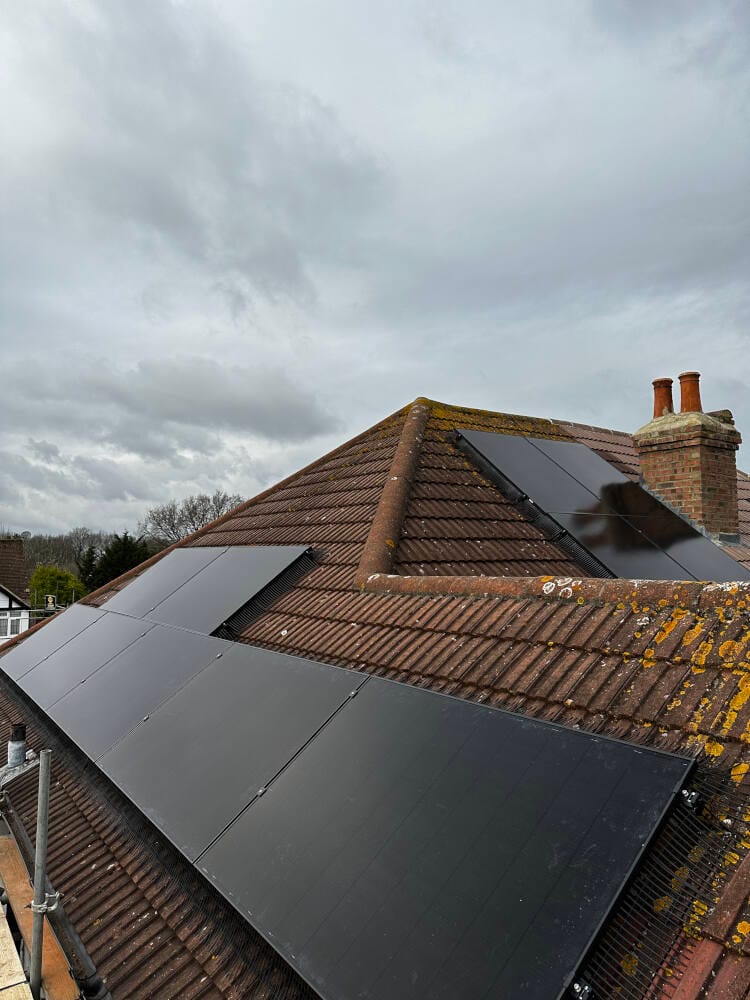
Quick answer: For an unshaded, south-facing roof, usually yes. PVGIS puts a 4 kWp array in Sevenoaks at 4,192 kWh a year. For a home using 2,500 kWh a year at the October to December 2026 price cap rate of 26.32p per kWh, with exports paid at 12p, that is worth about £611 a year without a battery and £839 with a 10 kWh battery. Coutts Electrical’s guide price for a 4kWp system with 10kWh battery capacity starts from £9,500, including VAT, currently 0% until 31 March 2027 and confirmed in your written quotation. At that price, payback takes about 11 years. An east- or west-facing roof takes nearer 14. Heavy shade, a short stay or a poor export rate can push payback past the point where solar makes sense.
This guide compares the cases: with and without a battery, south against east or west, and what happens when the unit rate moves. For one home worked through line by line, see our guide to solar panel cost in Kent.
The assumptions behind every figure
If your own figures differ from these, the answer moves.
- Generation. PVGIS 5.3, the European Commission’s Joint Research Centre model, for an unshaded 4 kWp array tilted at 35° with 14% system losses. Facing south in Sevenoaks, that is 4,192 kWh a year. We ran the same point facing east and west on 15 October 2026.
- Household use. 2,500 kWh a year, Ofgem’s medium typical consumption for electricity from 1 July 2026.
- Share used at home. From MCS guidance document MGD 003, the lookup tables MCS installers use. Take a home empty for half the day, the table MCS says to use when occupancy is unknown, using 2,500 to 2,999 kWh and generating 3,900 to 4,199 kWh. It uses 18% of its solar output without a battery and 56% with 9.1 to 10.1 kWh of usable storage. We assume all 10kWh is usable; check the battery’s datasheet. If 10kWh is its nominal capacity, MCS counts 90% of it and the share falls to 55%, which takes the Sevenoaks figure with a battery from £839 to £833.
- Import price. 26.32p per kWh, Ofgem’s average for England, Scotland and Wales on a standard variable Direct Debit tariff, 1 October to 31 December 2026. It contains no VAT: the government removed VAT from electricity bills from 1 October 2026 to 31 March 2027.
- Export price. 12p per kWh, the Outgoing Octopus rate since 1 March 2026. It is a variable rate for Octopus customers with a smart meter that records half-hourly exports. Ofgem says each supplier sets its own Smart Export Guarantee rate, which must always be above zero.
- Price. Coutts Electrical’s guide price of from £9,500 for 4kWp with 10kWh battery capacity, including VAT, currently 0% until 31 March 2027. For solar without a battery, we use the DESNZ 2025/26 South East average of £1,859 per kW for systems up to 4 kW: £7,436 for 4 kWp. That is an average across installers, not a Coutts Electrical price.
“Payback” here is simple payback: the price divided by one year’s value. It leaves out panel ageing, price changes, borrowing costs and replacement parts.
With and without a battery, town by town
PVGIS yields barely change across this part of Kent and south-east London. Westerham and Tonbridge are 81 kWh a year apart, under 2%.
| Town | Generation, 4 kWp south (PVGIS) | Used at home: no battery / battery (MGD 003) | Value a year, no battery | Value a year, with battery |
|---|---|---|---|---|
| Westerham | 4,164 kWh | 18% / 56% | £607 | £834 |
| Orpington | 4,172 kWh | 18% / 56% | £608 | £835 |
| Sevenoaks | 4,192 kWh | 18% / 56% | £611 | £839 |
| Maidstone | 4,227 kWh | 17% / 53% | £610 | £828 |
| Tonbridge | 4,245 kWh | 17% / 53% | £613 | £832 |
All rows assume 2,500 kWh a year of use, a home empty half the day, 26.32p to import and 12p to export. Tonbridge and Maidstone generate slightly more but fall into the next MCS generation band, where a smaller share is used at home, so without a battery their values come out level with Sevenoaks, and with one slightly below it.
In every town a battery adds about £218 to £228 a year. In Sevenoaks it moves about 1,600 kWh from export at 12p to use at home, where each unit saves 26.32p. If you live nearby, our page on solar and electrical work in Sevenoaks covers the local details.
What a battery has to cost to earn its keep
The Energy Saving Trust puts a battery’s typical lifespan at 10 to 12 years. At about £228 a year, a battery in Sevenoaks returns roughly £2,300 to £2,700 over that life at today’s prices. Treat that as an upper estimate: MGD 003’s shares are for the first year, batteries fade with age, and some energy is lost in charging. On a flat-rate tariff, it pays its way if it adds less than that to the price. It can earn more if import prices rise or you use a time-of-use tariff, which the Energy Saving Trust says lets a battery avoid the more expensive periods. These figures don’t model that.
Every system on Coutts Electrical’s guide price list includes 10kWh of battery capacity, so compare those prices with the battery column. To see what storage adds, ask each installer you compare to price the system with and without it; MGD 003 says both self-consumption figures should be communicated. Our battery storage page explains how storage is installed alongside the array.
South against east or west
For Sevenoaks, PVGIS gives 3,332 kWh a year facing east and 3,311 kWh facing west, about 21% below south, slightly more than the Energy Saving Trust’s rule of thumb of 15-20%. With less generated, a larger share of it is used at home: 20% without a battery and 63% with one, from the 3,300 to 3,599 kWh row of the same MGD 003 table.
| Roof (Sevenoaks, 4 kWp) | Generation (PVGIS) | Value a year, no battery | Payback, solar only at £7,436 (DESNZ South East average) | Value a year, with battery | Payback at the from £9,500 guide price (4kWp, 10kWh) |
|---|---|---|---|---|---|
| South | 4,192 kWh | £611 | 12.2 years | £839 | 11.3 years |
| East | 3,332 kWh | £495 | 15.0 years | £700 | 13.6 years |
| West | 3,311 kWh | £492 | 15.1 years | £696 | 13.6 years |
Which?’s May 2026 analysis points the same way: 11 years 3 months in London for an unshaded south-facing roof, and 16 years 1 month for an east-facing roof with modest shading. It modelled a 4.6kWp system costing £7,400, electricity at 25.8p, 12p export and someone home during the day.
How payback moves with the unit rate
The October to December 2026 cap is one point on a moving line. Here is the south-facing Sevenoaks home at other unit rates, export held at 12p.
| Import unit rate | Value a year, no battery | Payback, solar only at £7,436 | Value a year, with battery | Payback at the from £9,500 guide price |
|---|---|---|---|---|
| 20p | £563 | 13.2 years | £691 | 13.8 years |
| 26.32p (Ofgem cap, Oct–Dec 2026) | £611 | 12.2 years | £839 | 11.3 years |
| 30p | £639 | 11.6 years | £926 | 10.3 years |
| 35p | £677 | 11.0 years | £1,043 | 9.1 years |
The battery system responds more to the unit rate, because £618 of its £839 comes from imports you avoid. Solar on its own leans on the export rate: at 12p, export makes up £412 of its £611. At half that, 6p, solar alone would be worth about £405 a year and take about 18 years to pay back at the DESNZ average price. With a battery it would be worth about £729, about 13 years.
Ofgem announces the January to March 2027 cap on 25 November 2026. Its figures are national averages, so the unit rate on your own bill is the better number to use.
When solar is not worth it
These are the cases where solar often doesn’t pay.
- A shaded roof. The Energy Saving Trust says nearby buildings, trees or chimneys can shade a roof and cut performance; optimisers limit the damage when one panel is shaded. Every PVGIS figure here assumes no shade.
- A short stay. With payback at 11 to 15 years, selling within a few years means paying the full cost and collecting only part of the savings.
- An empty house by day, and no battery. If you’re out all day, MGD 003 puts self-consumption at 13% for the Sevenoaks roof, so most of the output earns the export rate. Solar alone is then worth about £581 a year, against £839 with a battery.
- A roof that needs work. The Energy Saving Trust notes that renewing the roof covering is sometimes recommended before panels go on. Re-roofing later means lifting the array and refitting it.
- A north-facing roof. The Energy Saving Trust doesn’t recommend panels there.
- Parts that wear out. The Energy Saving Trust expects panels to last 25 years or more, but an inverter needs replacing after around 12 years. Over 25 years, budget for at least one inverter and one battery replacement, which simple payback leaves out.
The Kent picture
DESNZ figures show Sevenoaks District had 3,282 sites with solar PV at the end of 2025, up from 1,783 at the end of 2020. Tonbridge and Malling more than doubled, from 1,768 to 3,652, and Maidstone rose from 3,266 to 5,715. That shows how common panels have become, not whether they will pay on your roof.
Sevenoaks, Tonbridge and Maidstone all sit in UK Power Networks’ South Eastern Power Networks area, and your installer registers the system with the network operator. Most roof-mounted panels on houses don’t need planning permission. A listed house or an Article 4 direction changes that, and in a conservation area panels can’t go on a wall facing the road: see our guide to solar panels and planning permission in Kent. For VAT relief and other help with the cost, see grants and schemes for solar in Kent. If you’re weighing a group-buying offer, our guide to Switch Together Kent, formerly Solar Together, explains how it works.
Getting a figure for your own roof
You can rough out this sum before anyone visits:
- Find your annual electricity use, in kWh, on your bills.
- Pick the pattern that fits: someone in all day, out half the day, or out all day.
- Note which way your roof faces and what shades it.
- Ask each installer for self-consumption with and without storage.
Coutts Electrical is MCS certified for solar PV, as its TrustMark register entry (licence 2677315) shows. Our quotes are provided to suit your individual needs, based on usage profile, time of use and available roof space, and the guide prices are for information. Every install includes DNO G98/G99, a 6 year financial protection policy, scaffolding, and MCS registration and certificate as standard. VAT applicability is confirmed in your written quotation. Our solar PV installation page covers the design and installation work. To have your own roof worked out, get in touch or call 0800 112 5050.
Questions people ask
Is solar worth it in Kent if my roof faces east or west?
Usually, but it takes longer. In Sevenoaks, PVGIS gives 3,332 kWh a year facing east and 3,311 kWh facing west, against 4,192 kWh facing south. That is about 13½ years’ payback with a battery at the from £9,500 guide price, or about 15 years for solar only at the DESNZ South East average price.
How long does solar take to pay for itself in Kent?
About 11 to 12 years for an unshaded, south-facing 4 kWp array at the October 2026 cap rate and 12p export. The Energy Saving Trust gives 9 years for London and Which? 11 years 3 months, on different assumptions.
Does a battery make solar pay back faster?
It adds about £228 a year in Sevenoaks at today’s rates, at most roughly £2,300 to £2,700 over the Energy Saving Trust’s 10 to 12 year battery lifespan. Whether it shortens payback depends on how much the battery adds to the price.
Is solar worth it if I’m out at work all day?
Without a battery, MGD 003 puts the share used at home at 13%, so most of the value comes from export. A battery raises that to 56%, adding about £258 a year in Sevenoaks, more than for any other occupancy pattern.
Does the VAT change in April 2027 affect payback?
HMRC zero-rates solar panels and batteries installed in homes until 31 March 2027, with 5% from 1 April 2027. On its own, 5% on a £9,500 price would make £9,975, stretching payback from about 11.3 to 11.9 years. VAT is also off electricity bills only until 31 March 2027. With 5% back on the 26.32p rate, the battery system would be worth about £870 a year, and payback at £9,975 about 11.5 years.
Sources
- European Commission Joint Research Centre, “PVGIS 5.3” (SARAH3 database; 4 kWp, 35° tilt, 14% system loss, unshaded). Town figures read 6 October 2026; Sevenoaks east and west run 15 October 2026: re.jrc.ec.europa.eu
- Ofgem, “Energy price cap unit rates and standing charges”, 1 October to 31 December 2026, accessed 15 October 2026: ofgem.gov.uk
- Ofgem, “Changes to energy price cap between 1 October and 31 December 2026”, 26 August 2026: ofgem.gov.uk
- Ofgem, “Review of typical domestic consumption values: decision”, 27 May 2026: ofgem.gov.uk
- MCS, “MGD 003: Solar PV Self-Consumption”, Issue 2.0, 1 April 2022 (Tables 7-3, 7-12 and 7-21): mcscertified.com
- Octopus Energy, “Outgoing Octopus” tariff page, accessed 15 October 2026: octopus.energy
- Octopus Energy, “Why are Outgoing Octopus export prices changing on March 1st 2026?”, no publication date given, accessed 15 October 2026: octopus.energy
- Ofgem, “Smart Export Guarantee (SEG)”, accessed 15 October 2026: ofgem.gov.uk
- DESNZ, “Solar PV cost data”, updated 28 May 2026 (“Regional costs (TIC)”, 2025/26 mean; includes VAT where applicable and mixes domestic and non-domestic installs): gov.uk
- DESNZ, “Regional renewable statistics: Renewable electricity by local authority, 2014 to 2025”, updated 29 September 2026: gov.uk
- Energy Saving Trust, “Solar panels: costs, savings and benefits explained”, last updated 1 October 2026: energysavingtrust.org.uk
- Energy Saving Trust, “Battery storage”, last updated 6 October 2026: energysavingtrust.org.uk
- Which?, Karen Lawrence, “Are solar panels worth it?”, 15 May 2026 (Energy Saving Trust calculator; 4.6kWp, £7,400, 25.8p electricity, 12p export): which.co.uk
- HMRC, “VAT on energy-saving materials and heating equipment (VAT Notice 708/6)”, updated 31 January 2024: gov.uk
- Elexon grid supply point group for TN13 1AA, TN9 1AA and ME14 1AA, via the Octopus Energy industry lookup, read 15 October 2026: api.octopus.energy
- TrustMark, register entry for Coutts Electrical Contractors Ltd, licence 2677315, accessed 15 October 2026: trustmark.org.uk
- Coutts Electrical, solar PV guide prices and inclusions, as published on couttselectrical.co.uk: solar PV installation
01 More from the blog
Keep
reading.
Commercial EICRs: Who Is Responsible and How Often?
Who is responsible for a commercial EICR, how often offices, shops and industrial units need one, what C1, C2, C3 and FI mean, and what to do next.
How Much Does an Electrician Cost? Call-Out Fees and Rates
Electrician call-out fees, hourly and day rates, and sourced prices for sockets, light fittings, fault finding, EICRs and fuse box upgrades.
Do you need planning permission for solar panels in Kent and Bromley?
Most home solar in Kent and Bromley is permitted development. The limits, the conservation area, listed building and flat exceptions, and what to check.