Domestic electrical 8 min read
Part P explained: which electrical work in your home needs building regulations sign-off (2026)
Which home electrical jobs are notifiable under Part P in England, room by room: new circuits, consumer units, bathrooms, and the certificates to expect.


Quick answer: In England, Part P of the Building Regulations makes three kinds of electrical work in a home notifiable: installing a new circuit, replacing a consumer unit, and any addition or alteration to existing circuits in a special location, which mainly means the space around a bath or shower. Everything else, including replacements, repairs and maintenance anywhere in the house, is not notifiable, though it must still be done safely. Notifiable work has to be certified in one of three ways, and you should end up with a Building Regulations compliance certificate.
This guide sets out what that means room by room. It is based on Approved Document P (the 2013 edition, which is the current one for England), read on 10 November 2026. If you want the work done rather than explained, our domestic electrician page covers the jobs we do across Bromley, Croydon and west Kent.
What Part P is
Part P is the section of the Building Regulations that deals with electrical safety in dwellings. It requires electrical installations in homes to be designed and installed so that they protect people from fire and electric shock, and Approved Document P is the government’s guidance on how to meet that requirement.
It applies to houses and flats, to the common parts of a block of flats, and to outbuildings such as sheds, garages and garden rooms that take their supply from the house. The technical standard behind it is BS 7671, the wiring regulations, which is why the paperwork you receive is a BS 7671 certificate.
The three kinds of notifiable work
Regulation 12(6A) of the Building Regulations lists exactly what is notifiable. Approved Document P repeats it word for word:
- The installation of a new circuit. Any circuit that starts at the consumer unit and did not exist before: a cooker radial, a shower circuit, a supply to a garden room, a dedicated circuit for an EV charger.
- The replacement of a consumer unit. Whatever the reason, including an upgrade from an old fuse box to a board with RCD protection.
- Any addition or alteration to existing circuits in a special location. A special location is the space around a bath or shower, or a room containing a swimming pool or a sauna heater.
Approved Document P is explicit that everything else is not notifiable: “additions and alterations to existing installations outside special locations, and replacements, repairs and maintenance anywhere.”
Notifiable or not: common jobs at a glance
| Job | Notifiable in England? | Why |
|---|---|---|
| Replacing a consumer unit or fuse box | Yes | Named in regulation 12(6A) |
| New circuit for an oven, hob or shower | Yes | A new circuit |
| New circuit to a garden room, gate or garage | Yes | A new circuit |
| Extra socket on an existing kitchen ring | No | Addition outside a special location |
| Outdoor light on an existing circuit | No | Addition outside a special location |
| New light or fan next to a bath or shower | Yes | Addition inside a special location |
| Replacing a light fitting, switch or socket | No | A replacement |
| Built-in cooker on an existing cooker circuit | No | No new circuit needed |
| Full or partial rewire | Yes | New circuits |
The cooker line comes straight from Approved Document P, which uses it as an example: installing a built-in cooker is not notifiable unless a new cooker circuit is needed. The same logic covers an electric gate or garage door. Connecting it to an existing isolator is not notifiable, but running a new circuit from the consumer unit to that isolator is.
Kitchens
Kitchens used to be special locations, and a lot of advice online still treats them that way. Since the 2013 changes in England they are not. An extra double socket on an existing ring, or under-cupboard lighting fed from an existing lighting circuit, is not notifiable.
What usually makes a kitchen job notifiable is load. Induction hobs, double ovens and some appliances need their own circuit, and a new circuit is notifiable wherever it goes. That is often the point where a kitchen refit turns into a conversation about the board, because a new circuit needs a spare way and suitable protection at the consumer unit.
Bathrooms and shower rooms
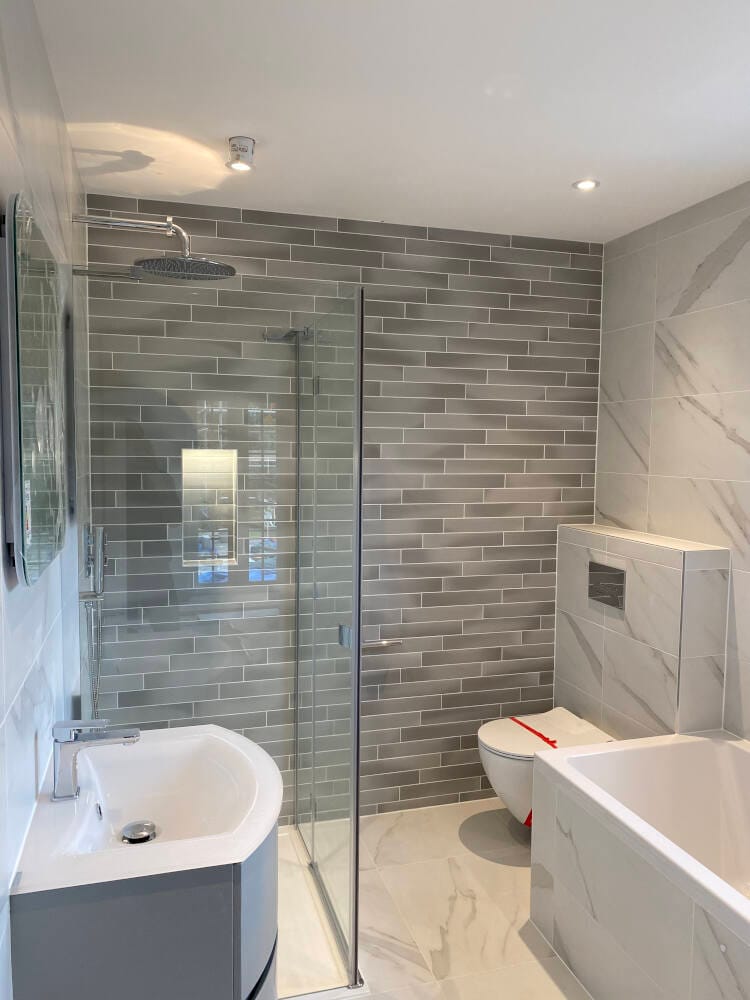
Bathrooms are where Part P is strictest. Approved Document P defines the special location around a bath or shower as the space up to 2.25 metres above the finished floor (or up to the shower head if that is higher), and out to 0.6 metres from the edge of the bath or shower tray. Where there is no tray, it runs 1.2 metres from the centre of the shower head.
Inside that space, even a minor addition or alteration to an existing circuit is notifiable. Moving a light, adding an extractor fan or wiring a heated towel rail within the zone all count. The guidance also notes that socket-outlets should not be located within 3 metres of a bath tub or shower tray, which is why bathroom power usually means a shaver point or a fused spur outside the zone.
Gardens, outbuildings and EV chargers
Outdoor work follows the general rule. A light or socket added to an existing circuit is not notifiable; a new circuit is. In practice most garden rooms, workshops and outbuildings need a new circuit from the consumer unit, often as a buried armoured cable, so they are notifiable.
The same applies to a home EV charger, which normally has its own dedicated circuit. A charger also has to be notified to the local network operator, which is a separate process from building control. For the charger side, see our guide to common mistakes when installing an EV charger at home.
Rewires and consumer unit upgrades
A rewire is notifiable because it installs new circuits, and a consumer unit replacement is notifiable in its own right. They often happen together. If the testing on an older house shows the wiring is sound and only the board is out of date, a board change alone may be the right job; if the insulation readings are poor across the installation, a rewire is.
Our guides to the signs a home needs rewiring and to what separates a consumer unit from a fuse box cover how to tell which situation you are in.
The three ways notifiable work gets certified
Approved Document P sets out three routes:
- Self-certification by a registered competent person. The installer is registered with a competent person scheme. They complete a BS 7671 Electrical Installation Certificate for the job, and within 30 days of completion the installer or their scheme must give the occupier a copy of the Building Regulations compliance certificate and notify building control.
- Third-party certification. An installer who is not a registered competent person appoints a registered third-party certifier before work starts. Within 5 days of finishing, the installer notifies the certifier, who inspects and tests the work.
- Building control. A building notice or full plans application goes to the building control body before the work starts, and building control inspects it.
For a homeowner the first route is the simplest, because the notification happens without you having to deal with the council. Whichever route is used, the inspection and test forms should be given to the person who ordered the work.
Which certificate you should receive
There are two kinds of paperwork, and it helps to know which is which:
- The BS 7671 certificate, from the electrician, for every job. An Electrical Installation Certificate covers a new circuit or a new installation. A Minor Electrical Installation Works Certificate covers an addition or alteration to an existing circuit. An Electrical Installation Condition Report records an inspection of an existing installation rather than new work.
- The Building Regulations compliance certificate, for notifiable work only. This shows the work was notified and certified under the Building Regulations.
Keep both with the house deeds. A buyer’s solicitor will usually ask for them when you sell, and a missing compliance certificate for a rewire or a board change is a common cause of delay.
What happens if notifiable work was never certified
Approved Document P makes the point that the building owner may be responsible for making sure work complies, and that an owner can be served with an enforcement notice if building work does not comply. In practice the problem usually surfaces at sale, or when an insurer asks for the paperwork after a claim.
If you have bought a house with an unexplained new board or extension wiring and no certificates, an Electrical Installation Condition Report is the sensible first step. It tells you what condition the installation is actually in, which is the question that matters most.
Landlords
Part P applies to rented homes in the same way, and Approved Document P allows the Building Regulations certificate to be given to the person who ordered the work and copied to the occupier. Landlords also have a separate duty under the Electrical Safety Standards in the Private Rented Sector (England) Regulations 2020 to have the installation inspected and tested at least every five years. Our landlord electrical checks guide covers that duty.
Getting the work done
If a job on your list is notifiable, the practical step is to use an electrician who can certify it, and to ask at the quotation stage which certificates you will receive. Our domestic electrical services include new circuits, consumer unit upgrades, rewires and bathroom and outdoor electrics, all tested and certified at handover. For a new installation such as an extension or outbuilding, see electrical installations, and if something has stopped working, electrical repairs.
We work from Keston across the London Borough of Bromley, Croydon and west Kent, including Sydenham and Chislehurst. Call 0800 112 5050 to describe the job.
Frequently asked questions
Is replacing a light fitting notifiable under Part P?
No. Replacing an accessory such as a light fitting, switch or socket on the same circuit is a replacement, and Approved Document P says replacements, repairs and maintenance are not notifiable anywhere in the home, bathrooms included. The work still has to be done safely and to BS 7671.
Do I need building regulations approval to add a socket in my kitchen?
Not if the socket goes on an existing circuit. Since 2013 a kitchen in England has not been a special location, so an addition to an existing kitchen circuit is not notifiable. A new circuit, such as a dedicated radial for an oven or hob, is.
Is a consumer unit replacement notifiable?
Yes. Replacing a consumer unit is one of the three kinds of notifiable work listed in regulation 12(6A) of the Building Regulations, whatever the reason for the change.
How long does the installer have to send the Building Regulations certificate?
Where a registered competent person does notifiable work, the installer or their registration body must give the occupier a copy of the Building Regulations compliance certificate, and notify building control, within 30 days of the work being completed.
Does Part P apply in Wales and Scotland?
This guide covers England. Wales applies its own version of the Building Regulations and Scotland has a separate building standards system, so the list of notifiable work is not the same there.
Sources
- HM Government, “Approved Document P: Electrical safety – Dwellings”, 2013 edition, regulation 12(6A) and paragraphs 2.5 to 2.8 and 3.1 to 3.6 (read 10 November 2026): gov.uk
- The Electrical Safety Standards in the Private Rented Sector (England) Regulations 2020: legislation.gov.uk
01 More from the blog
Keep
reading.

Warm Homes Loan Scheme rules: what it covers for solar panels, batteries and EV chargers
The Warm Homes Loan Scheme rules for homes, checked 3 Nov 2026: who can borrow, the £15,000 solar and battery caps, EV chargers, MCS installers, audits.
Common Mistakes to Avoid When Installing an EV Charger at Home (2026)
Mistakes that leave a home EV charger unsafe, slow or without a grant: three-pin charging, supply and earthing checks, DNO notice, Part P and OZEV rules.

How Much Does an Electrician Cost? Call-Out Fees and Rates
Electrician call-out fees run £60-£120 in 2026, or £90-£150 in London and the South East. Hourly and day rates plus 7 job prices, each sourced.